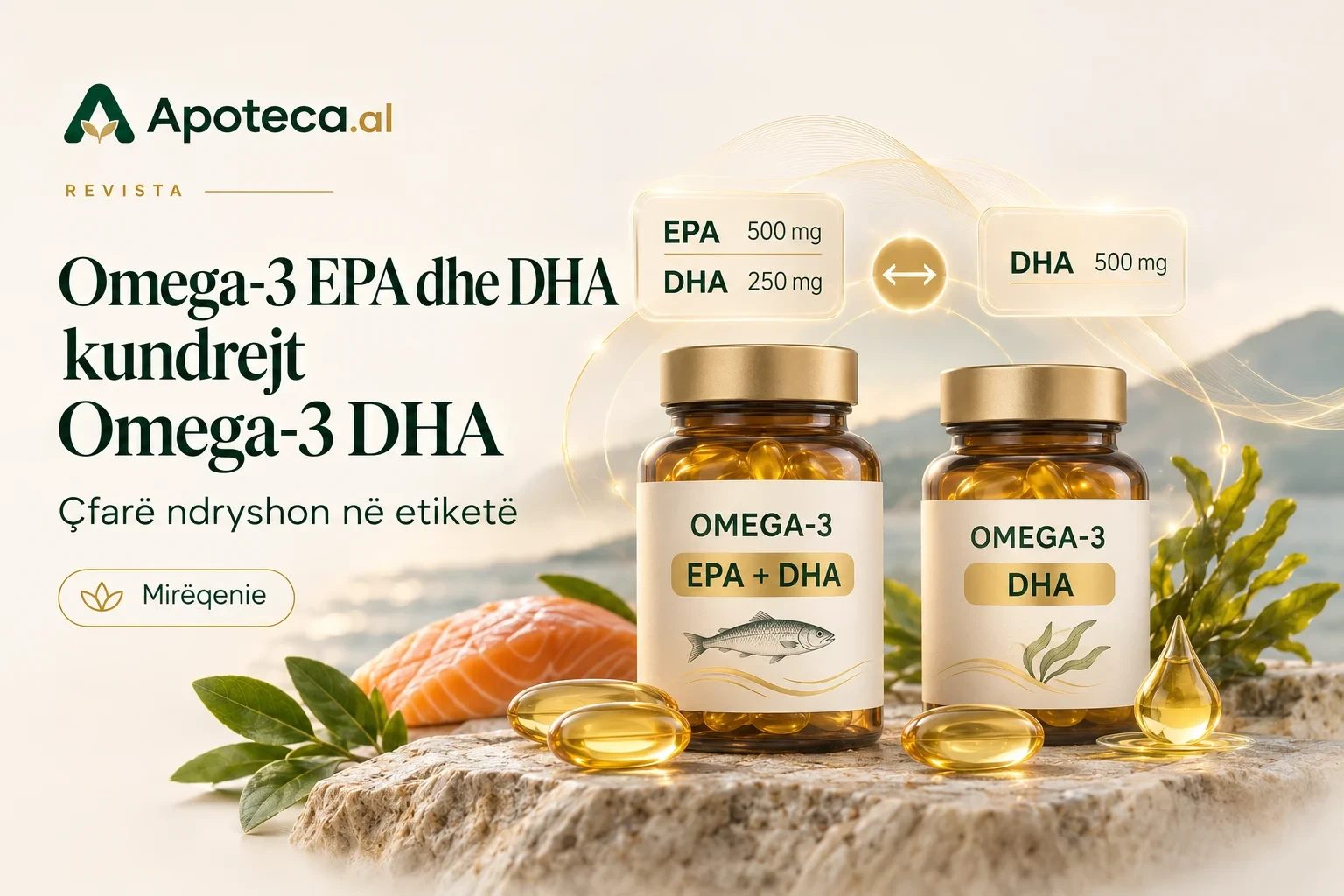
What differs between EPA+DHA and DHA (as shown on the label)
-
Active-ingredient declaration: on the label, “Omega-3 EPA and DHA” is typically shown as two separate lines (EPA in mg and DHA in mg). “Omega-3 fatty acid DHA” may list DHA only in mg; EPA may be absent or simply not declared.
-
EPA:DHA split (as the label allows): with “EPA and DHA” products, the two numbers (e.g., EPA mg / DHA mg) make side-by-side comparison across the catalogue straightforward. With “Omega-3 DHA”, the comparison usually centres on DHA mg per serving, because the label is not built around a split.
-
“Total omega-3” vs “EPA + DHA”: some labels highlight a larger figure such as fish oil or total omega-3, and then list EPA and DHA underneath. For comparing these ingredient lines, the reference point is the declared EPA and/or DHA mg, not the total oil mg.
-
Product format (as shown in the catalogue and on the product page): for “Omega-3 EPA and DHA”, the catalogue format is Softgels. For “Omega-3 DHA”, formats can vary (e.g., capsules, softgels, liquid) and should be confirmed on the product page without assumptions.
-
Excipients and oil source: labels may list capsule materials (e.g., gelatin, glycerin), antioxidants (e.g., tocopherols), flavourings, and the source (e.g., fish or algae). These differences shape practical preferences and price per dose, not a “better vs worse” judgement.
Which option fits which shopping preference
-
For shoppers who want two-number transparency: “Omega-3 EPA and DHA” fits the preference of seeing both values (EPA mg and DHA mg) on the same label, making comparisons across options clearer.
-
For shoppers who prefer a single headline number: “Omega-3 fatty acid DHA” suits a label where DHA mg per serving is the main metric, without tracking two separate lines.
-
For format and swallowability: with EPA+DHA, the catalogue format is Softgels, which makes the format experience more predictable. With DHA-only, the decision depends on the exact format shown on the product page and the serving size (e.g., 1 unit vs 2 units).
-
For dietary and excipient preferences: many shoppers decide based on capsule material (e.g., gelatin versus plant-based alternatives when declared) and whether flavourings are included. These details sit in the ingredients list and can be decisive regardless of whether the label is EPA+DHA or DHA-only.
-
For budget and fair comparison: the cleanest comparison uses price per dose alongside EPA+DHA mg per serving (combined products) or DHA mg per serving (DHA-only). A product only looks more economical after calculating on the full serving.
What to look for on the label (concretely)
-
Key numbers to find first
- For “Omega-3 EPA and DHA”: look for EPA mg and DHA mg per serving.
- For “Omega-3 DHA”: look for DHA mg per serving.
- In both cases: confirm how many units make one serving (e.g., 1 softgel, 2 capsules, 5 ml). This detail changes how numbers should be compared.
-
Avoid mixing up “total oil” with fatty acids
- If the label lists “fish oil”, “algal oil”, or “total omega-3”, that is a total category figure.
- For comparisons, use only the declared EPA and/or DHA mg, because those are the standardised label numbers.
-
Excipients list (for practical preferences)
- Capsule materials: e.g., gelatin, glycerin.
- Antioxidants: e.g., tocopherols.
- Flavourings: when declared, they matter for taste/odour preferences.
-
Source and allergens (as purchasing information)
- The label may state the source (e.g., fish or algae) and allergen warnings. Consider these as selection criteria, not as “strength” indicators.
-
Value calculation: mg per serving vs price per dose
- For EPA+DHA: calculate (EPA mg + DHA mg) per serving and compare it to price per dose.
- For DHA-only: calculate DHA mg per serving and compare it to price per dose.
- If the label lists mg “per 1 capsule” but the serving is “2 capsules”, multiply before comparing.
How they are typically used (with the label as the authority)
-
Dose and directions are set by the label: the manufacturer’s directions on the label and product page are the authority. If anything is unclear about serving size or label reading, product questions go to the Apoteca team; health questions belong with a doctor.
-
Always follow the declared serving: some products are designed as “1 unit daily”, others as “2 units”. When comparing EPA+DHA with DHA-only, use the full serving, not a per-capsule number when the serving is larger.
-
Timing follows what is written: when the label specifies timing (e.g., “with food”), follow it. When it does not, avoid improvising; stick to what the manufacturer declares.
-
Combining with other products: some labels include cautions or limits for concurrent use. When they do not, decisions should still respect each product’s directions and involve a doctor for personal medical questions.
-
Storage is part of practical use: check label instructions (e.g., temperature, away from light; and for liquids, after-opening directions).
Tradition and research: questions worth asking
In the EU food-use framing reflected in EU health-claim rules, “Omega-3 EPA and DHA” and “Omega-3 fatty acid DHA” appear as food constituents where supplement labels can be standardised in mg per serving/day (e.g., 250 mg/day or 2 g/day), unlike fatty fish/marine oils eaten as foods, which are not typically labelled in mg EPA/DHA per plate, according to Commission Regulation (EU) No 432/2012 (consolidated).
In an EFSA Journal Scientific Opinion (2026), “Omega-3 fatty acid DHA” (DHA) is discussed in the context of supplemental intakes (e.g., 2–4 g/day in some described interventions) and blood measurements (e.g., lipid markers), but the document does not report a direct head-to-head comparison of “Omega-3 EPA and DHA” versus “Omega-3 fatty acid DHA” as two label formulas within the same trial.
According to Commission Regulation (EU) No 432/2012 (consolidated), when the triglycerides claim is used for “Omega-3 EPA and DHA” on supplements/fortified foods, an additional statement is required that consumers should not exceed 5 g/day EPA+DHA from supplements and that the claim shall not be used for foods targeting children; this kind of regulatory label restriction is a general note and does not replace a doctor’s advice for personal questions.
According to Codex Alimentarius (CXS 329-2017), fish-oil quality (a potential source for “Omega-3 EPA and DHA” or “Omega-3 fatty acid DHA”) includes oxidation indicators such as peroxide value and anisidine value with specified maximum limits; these are analytical quality-control parameters that may be reported on labels or may be absent, depending on the manufacturer.